Hytale Character Creator vs Minecraft Skins
Compare Hytale's layered character creator with Minecraft Java skins and Bedrock Character Creator: editing, detail, sharing, files, and best use cases.
The difference between Hytale character recipes and Minecraft skins is not just graphics. It is the kind of craft each system rewards.
Minecraft skins are flat texture files wrapped around a player model. The official Minecraft guide describes a skin as a pixel painting that changes how your character looks, and Java players can import a flat PNG skin through the launcher. Minecraft Bedrock also has a Character Creator and Dressing Room, but the classic skin culture is still strongly file-based. Hytale works differently for this archive: a useful Hytale page is a manual recipe with screenshot evidence, recipe JSON, creator path, and notes about tradeoffs.
That is why this site does not promise Hytale import/export, one-click installation, or file replacement. We document fan-made recreations that players can rebuild by hand.
Source check: This comparison was reviewed on August 27, 2026 against Hytale's official Update 2 Avatar Customization notes and Chapter 1 Avatar Creator preview, plus Minecraft's official skin guide.
Hytale vs Minecraft character customization at a glance
| Question | Hytale Avatar Creator | Minecraft Java skins | Minecraft Bedrock |
|---|---|---|---|
| Core approach | Mix creator-provided body, hair, face, clothing, and color options. | Wrap a flat PNG texture around the classic or slim player model. | Choose between classic skins and an item-by-item Character Creator in the Dressing Room. |
| Where precision comes from | Silhouette, layered clothing, face framing, and the available cosmetic set. | Pixel-level control over the skin texture. | Equipped creator items or the selected classic skin. |
| Typical sharing format | For this archive, a screenshot plus a manual creator recipe and notes. | A skin file or a launcher-selected skin. | A saved Character Creator look, skin, or skin pack, depending on the item. |
| Best fit | Characters defined by hair, role, outfit layers, and color rhythm. | Characters defined by exact symbols, painted detail, and texture placement. | Players who want item-based customization or classic-skin support on Bedrock. |
| Main limitation | A recipe can only use the avatar options currently available. | The block model limits geometry even when the texture is precise. | Options and workflows differ from the Java skin-file path. |
Minecraft rewards surface control
Minecraft's classic skin system is powerful because it gives the creator direct control over the surface. If you can paint the right pixels, you can place a mark, trim, face expression, shading cue, or emblem exactly where you want it.
That makes Minecraft strong for characters whose identity depends on:
- precise printed symbols,
- tiny armor motifs,
- pixel-level face detail,
- exact front/back texture treatment,
- custom shading that is part of the design.
The tradeoff is that the craft lives in the file. A tutorial can explain the choices, but the main artifact is often the downloadable or uploaded skin itself.
Hytale rewards layered creator logic
Hytale's avatar creator is closer to a layered character system. The current official Update 2 notes document face options, haircut visuals, cosmetic colors, armor visibility, and color-name tooltips in Avatar Customization. The July 2026 preview says the Avatar Creator will keep gaining player-model details and cosmetics.
For a Hytale recipe, the important decisions are:
- which hair silhouette carries recognition,
- which torso or overtop creates the main costume read,
- which skin tone works beside hair and outfit,
- which accessory improves recognition without adding noise,
- which limitation needs to be disclosed because the creator cannot match the source exactly.
That is a different kind of work. You are not painting every detail. You are translating a character into Hytale's available creator language.
Why a Hytale page needs more than settings
A thin Hytale preset page would only list selected options. That is not enough. If the creator changes, the settings alone may stop being clear. If a screenshot is cropped poorly, the page may look better or worse than the actual recipe. If a character needs an unavailable accessory, the player needs to know the limitation before wasting time.
A stronger Hytale page includes:
- a real screenshot of the finished preset,
- recipe JSON as structured evidence,
- a creator path that a player can follow manually,
- source disclosure,
- why-this-works notes,
- known limitations,
- alternatives or tweak notes,
- last review or content update context.
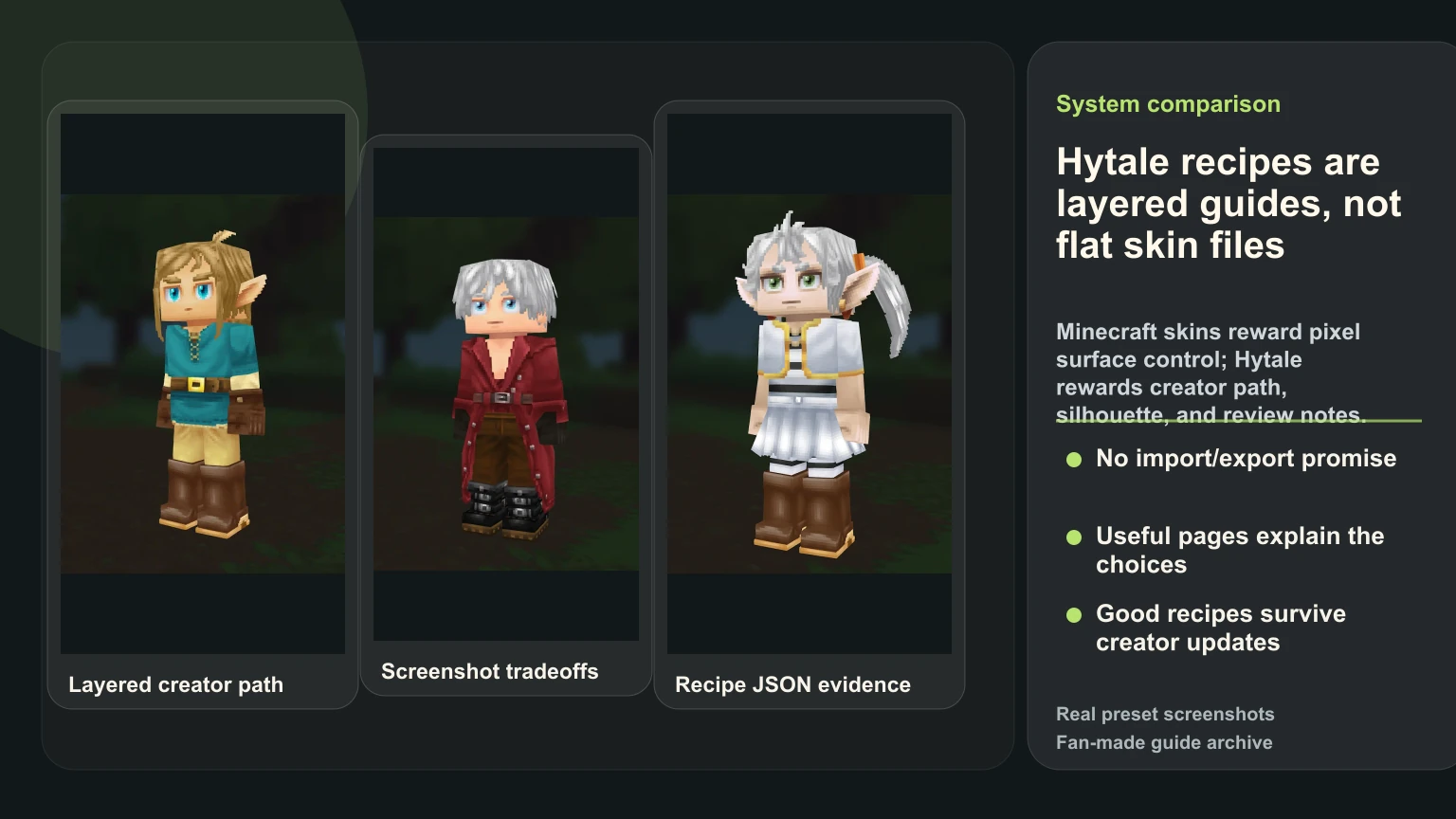
That is why Frieren, Link, and Dante are more useful as recipe pages than they would be as isolated images. The value is not only the look. The value is the reasoning behind the look.
Where Minecraft is clearly better
Minecraft still wins when a design depends on exact surface art. If a character's identity is a chest logo, tiny armor panel, complex face marking, or pixel-precise costume pattern, a skin editor can do things Hytale's creator should not be expected to do.
Minecraft also has a mature ecosystem. Players understand skins, skin editors, skin files, skin packs, and platform-specific differences. The official Minecraft skin guide explains both Java and Bedrock appearance workflows, while the Character Creator FAQ explains Bedrock's item-by-item creator model.
That ecosystem makes sharing direct. It also sets a different expectation: many users search for a file, not a manual recipe.
Where Hytale is clearly better
Hytale is strongest when the design survives through silhouette, role, and layered costume choices.
Good Hytale candidates often have:
- a readable hair mass,
- a tunic, coat, robe, or uniform block,
- a clear color rhythm,
- a face that does not require exact actor likeness,
- a source design that can feel natural inside Hytale's style.
Link works because tunic, boots, hair, and role silhouette carry the read. Frieren works because pale hair, calm cloth, and mage silhouette are enough to communicate the character. Dante works because the red coat structure can carry the page even when exact surface detail is simplified.
These are not perfect copies. They are Hytale translations. That is the honest standard.
How sharing changes
Minecraft sharing often starts with "use this skin." Hytale sharing should start with "here is how to rebuild this look."
That changes the page structure:
- Minecraft content can focus on the skin file and preview.
- Hytale content needs the manual creator path.
- Minecraft can preserve exact painted detail.
- Hytale must explain which compromises were intentional.
- Minecraft users may expect import steps.
- HytaleCharacter readers should expect a fan-made recreation guide.
This is also why recipe JSON on this site is evidence, not an install promise. It helps preserve the structured choices behind the build. It does not claim to modify Hytale account data or equip the character for you.
How to decide which system fits a character
Before you start a build, ask one question:
Does this character live on surface detail or layered identity?
Choose Minecraft-style skin work when the design needs:
- exact symbols,
- custom texture placement,
- painted shadows,
- very specific face markings,
- front/back pattern fidelity.
Choose Hytale recipe work when the design needs:
- strong silhouette,
- readable outfit layers,
- hair and face framing,
- color relationships,
- a look that fits Hytale's world.
This is not a better/worse debate. It is a translation decision.
What a good Hytale recipe should explain
If you are writing or submitting a Hytale recipe, do not stop at "I picked the closest options." Explain the choice:
- What carries recognition first?
- Which layer is the biggest compromise?
- What should a player preserve if a future update changes option names?
- What part of the source design is impossible right now?
- Which alternative option is worth testing?
That reasoning is what turns a preset into a guide. It is also what makes a page useful for search. A user who lands on a Hytale recipe needs help rebuilding the character, not a vague claim that the page has a "skin."
Why this matters for this archive
HytaleCharacter.com is trying to be a curated fan-made recipe archive. That means our best pages should look closer to reviewed build notes than to a pile of downloadable files. The About page explains the archive scope, and the Editorial Policy explains why screenshots, recipe JSON, creator path, known limitations, and manual review all matter.
Minecraft already has a deep skin-file culture. Hytale needs a different kind of resource: one that helps players translate references into Hytale's creator without pretending the process is automatic.
If you want to test the difference, compare the game character hub, anime hub, and movie hub. Then open Link, Frieren, and Jack Sparrow. The strongest pages are not the ones that claim perfect copying. They are the ones that show their work.