Best Characters to Recreate in Hytale First: Link, Frieren, and Other Easy Silhouettes
A practical list of Hytale-friendly first recreations, focused on characters and design archetypes whose silhouette, clothing layers, and color rhythm survive the avatar creator well.
The best first character to recreate in Hytale is not the most famous one. It is the one whose identity survives simplification. If the character still reads after you simplify the face, reduce the surface detail, and express the costume through Hytale's layered creator options, it is a good learning target.
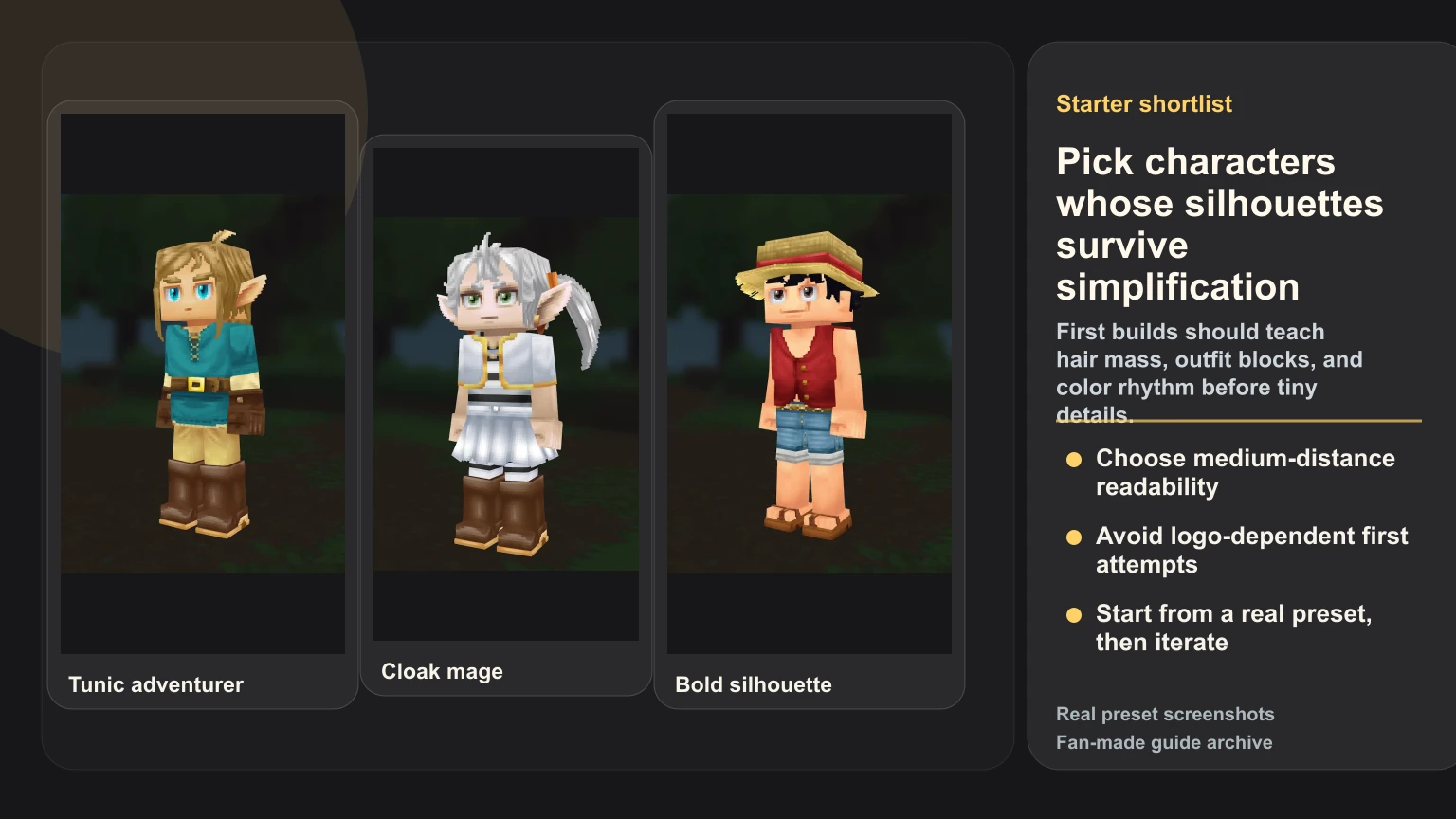
That is why Link, Frieren, and Luffy are useful starting points in this archive. They teach different fundamentals: role silhouette, calm color control, and bold readable identity. None of these pages is an official Hytale asset, import, export, or one-click install. They are fan-made manual recreation guides with screenshots, recipe JSON, creator paths, and limitations.
What makes a good first Hytale recreation?
Use this standard before choosing a target:
- The character is recognizable from medium distance.
- Hair, hat, cloak, coat, or outfit block carries the first read.
- The face can be simplified without losing the whole identity.
- The palette is clear enough to survive Hytale lighting.
- Missing tiny details can be explained honestly.
Bad first targets usually fail one of those tests. They depend on tiny logos, actor likeness, complex armor surface detail, or a specific texture pattern. Those characters can still be worth building later, but they teach limitation management before they teach the creator fundamentals.
1. Link-style tunic adventurers
Link is one of the cleanest beginner examples because the main read is structural:
- tunic,
- boots,
- belt or waist rhythm,
- blond hair,
- adventure role,
- green and brown color relationship.
You do not need every small source detail for the preset to read. That makes Link-style builds excellent practice for silhouette-first thinking. If the tunic and lower-body proportion are working, the character is recognizable even before accessories are perfect.
When building this archetype, protect the role silhouette first. Do not overwork the face. Do not chase tiny gear detail so hard that the tunic stops reading cleanly. Compare your work against Link and then check whether the screenshot still communicates "adventurer" at card size.
2. Frieren-style cloak mages
Frieren is useful because the character rewards restraint. The build depends on pale hair, calm face balance, light cloth, and a mage-like silhouette. It does not need a noisy accessory stack to work.
What this teaches:
- how to keep white and pale tones from flattening,
- how to let hair and outfit carry mood,
- how to avoid over-saturating a quiet character,
- how to write a useful known-limitations note.
The main trap is overcorrection. Builders often add too much contrast because the reference feels subtle. A better approach is to keep the screenshot calm and make sure the face still has enough presence beside the hair. Use Frieren with the anime skin tone guide as a practice pair.
3. Luffy-style bold silhouette characters
Luffy is not subtle, and that is why the character is useful. A straw hat, warm face, red vest, blue shorts, and open posture create a strong read even when details are simplified.
This teaches a different lesson from Frieren:
- one or two loud identity markers can be enough,
- color rhythm matters more than exact hue,
- the face should support the outfit rather than overpower it,
- a simple costume can still be archive-worthy if the screenshot is clean.
The main trap is saturation. If every red, yellow, and skin tone choice is pushed too hard, the preset becomes noisy. Compare Luffy at thumbnail size. If the hat and vest read immediately, the recipe is doing its job.
4. Gojo-style face-framed builds
Gojo is a stronger second or third build than a first build because the face accessory is so important. The silhouette is simple, but the blindfold read needs to land. Hytale Update 2 made this kind of build easier to audit because it added more face and blindfold-related options.
Build this when you are ready to practice:
- face framing,
- dark clothing restraint,
- hair mass,
- avoiding over-detail in a simple outfit.
The key is not to let the blindfold do all the work. The hair and dark outfit still need to support the identity. See Gojo Satoru and the Update 2 builder audit.
5. Jack Sparrow-style costume personalities
Jack Sparrow is a good practice target once you understand basic silhouette. The character depends on headwear, coat rhythm, facial hair read, and pirate costume language. That makes the recipe more limitation-heavy than Link or Frieren.
This kind of build teaches source disclosure and tradeoff notes. You will rarely match every movie-costume detail exactly, so the page needs to explain what the creator can express:
- pirate silhouette,
- red head wrap,
- dark coat,
- boot weight,
- face-framing accessory choices.
If the screenshot reads as a pirate first and the notes explain the missing details, the recipe can still be useful. Compare Jack Sparrow with the movie character hub.
6. Dante-style coat-led game characters
Dante-style builds are useful because the coat carries so much of the identity. The lesson is layer hierarchy: if the red coat read works, the page can survive several smaller compromises.
When building coat-led characters, ask:
- Is the coat the main identity layer?
- Are the legs too heavy or too plain?
- Does the hair support the role?
- Did I add accessories because they help, or because the source has details I feel guilty omitting?
This is the kind of build where a known-limitation note is part of the value. The player should know which exact detail is not possible and which layer matters most. Use Dante and the game character hub as references.
7. Original Hytale-native roles
Not every practice target needs to be a named franchise character. Some of the best first builds are Hytale-native roles:
- forest ranger,
- young mage,
- traveling knight,
- academy rogue,
- wandering healer,
- desert scout.
These are useful because they teach the same construction logic without forcing a canon comparison. You still practice silhouette, palette, and layer hierarchy, but you are not fighting an exact source image.
Original roles also strengthen a recipe archive. A site built only on famous names can become shallow. A mix of fan recreations and world-native presets shows that the creator has durable design value.
Characters to avoid as first attempts
Save these for later:
- designs carried by tiny chest logos,
- armor with exact panel patterns,
- actor-likeness movie characters,
- characters whose face expression is the main identity,
- outfits that rely on printed texture rather than layered clothing,
- references with multiple conflicting versions.
If you start with these, you will spend most of your time explaining limitations. That is useful eventually, but it is a rough way to learn.
A simple ranking for your first week
Try this order:
- Tunic adventurer.
- Cloak mage.
- Bold hat or costume silhouette.
- Face-framed simple outfit.
- Pirate or coat-heavy character.
- Original Hytale-native role.
- Complex armor or actor-likeness character.
This order builds skill in layers. You learn shape before you learn limitation notes. You learn color rhythm before you chase exact detail.
How to judge your first build
Before submitting or publishing a recipe, run this audit:
- Shrink the screenshot to card size.
- Ask whether the character reads before you look at the title.
- Check whether one layer is doing the main work.
- Remove one noisy detail and see if the build improves.
- Write one sentence explaining the main limitation.
- Confirm the page would help another player rebuild the look manually.
That last step is the whole point. A good Hytale recipe is not just a character idea. It is a repeatable guide.
For broader method, read how to recreate characters in Hytale, Hytale character creator mistakes, and our Submission Guidelines. Then start from a character whose silhouette gives the creator a fair chance.