How to Judge a Good Hytale Character Recipe
A practical editorial checklist for judging Hytale character recipes by screenshot evidence, recipe JSON, creator path, source disclosure, and known limitations.
A good Hytale character recipe is not just a name attached to a screenshot. It is a repeatable manual recreation guide. A player should be able to open the page, understand the source target, inspect the recipe JSON, follow the creator path by hand, and see where the build is strong or limited.
That standard is the difference between a useful archive and a thin preset list. Hytale Character Recipes is a fan-made archive, not an official Hytale resource and not an import, export, file replacement, or one-click installation tool. The value of a page is the editorial work around the recipe: why the choices were made, what the screenshot proves, what another player can safely repeat, and what still needs human judgement.
The broader purpose is explained on our About page, and the publishing rules are described in our Editorial Policy. This guide turns those rules into a practical checklist for judging a recipe, submitting a variation, or deciding whether a page belongs.
Start with the source target
The first question is not "does this look cool?" The first question is "which version of the character is this trying to rebuild?"
Many characters have several valid versions. Link can be a classic green tunic hero, a blue Breath of the Wild-style adventurer, or a rougher travel version. Dante can shift between eras. Luffy can be a clean Straw Hat captain, a post-timeskip variant, or a special form. If a recipe mixes those targets without saying so, the page becomes hard to judge.
A good recipe names or implies a stable source target:
- the character and source series;
- the costume, era, or version when that matters;
- the visual cues that should survive in Hytale;
- the things Hytale cannot express directly.
That is why the Link recipe is clearer when it says the visible build is a blue-tunic direction. It avoids pretending every Link searcher expects the same outfit. The Dante recipe works for the same reason: it treats the red-coat version as the target instead of blending every Devil May Cry era into one vague page.
Judge the screenshot before the settings
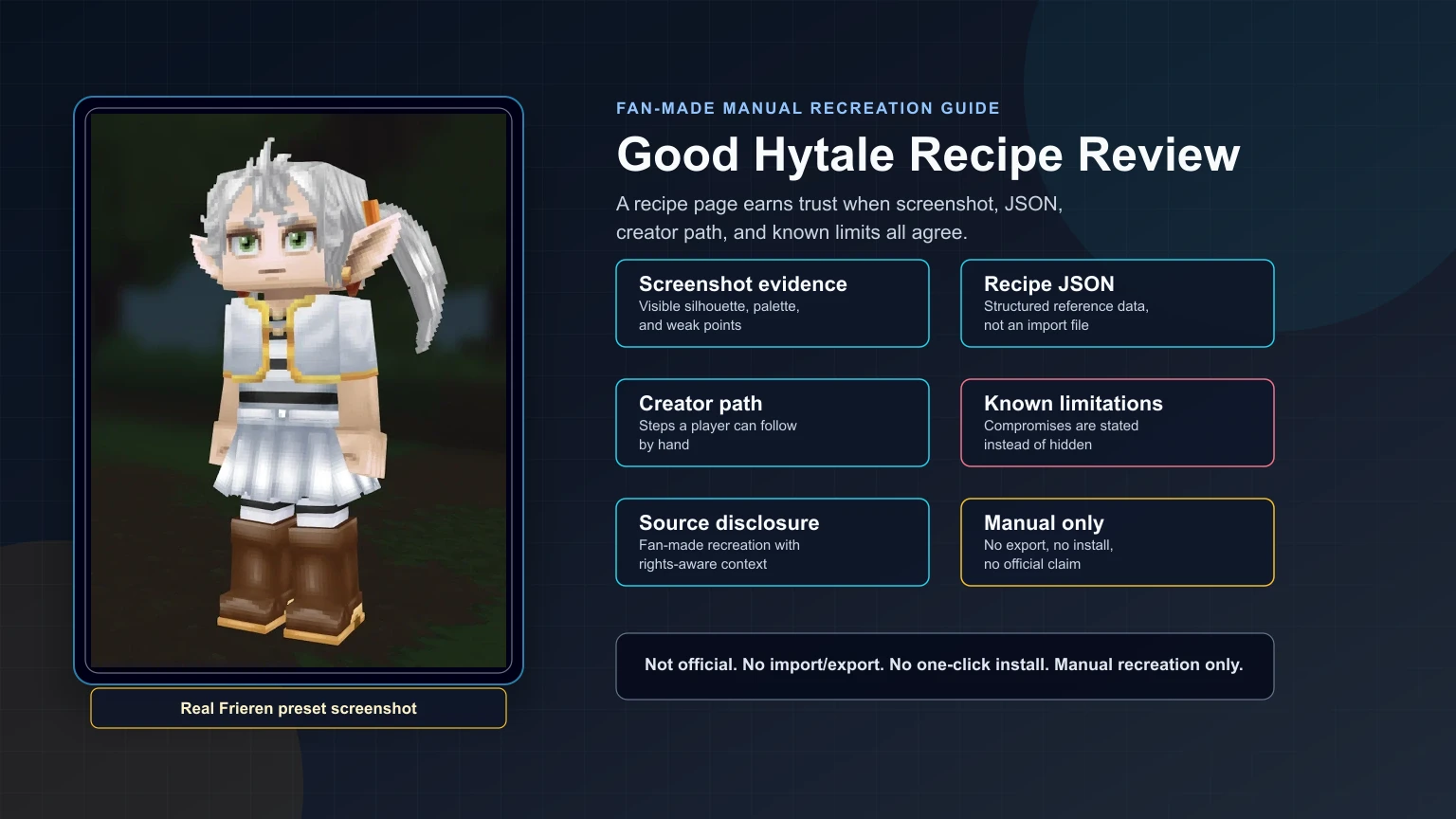
The screenshot is the fastest quality signal. It tells you whether the recipe actually reads as the intended character before you inspect the menu path.
Look for four things:
- Silhouette: hair mass, head shape, body proportion, coat length, cloak shape, or hat visibility.
- Palette: the main color blocks should still make sense after Hytale lighting and shading.
- Costume rhythm: torso, legs, shoes, and accessories should work as one outfit.
- Crop honesty: the screenshot should not hide the part of the build that is weakest.
The Frieren recipe is a good example because the screenshot has to protect white hair, elf ears, green eyes, pale robe structure, dark anchors, and boots. If those pieces are visible, the page has a real visual basis. If the same recipe used a crop that hid the ears and lower body, the JSON might still be accurate, but the public page would be weaker.
Screenshot evidence is also why a recipe can be simple and still valuable. The Luffy recipe does not need dozens of parts. The straw hat, black hair, cheek scar, red vest, blue shorts, and sandals are enough if the screenshot shows them clearly.
Read the recipe JSON as evidence, not as an import file
Recipe JSON preserves choices. It lets an editor inspect what the page claims, compare it with the visible screenshot, and translate it into a creator path.
But recipe JSON is not the same thing as an official import file. A public recipe page should never imply that a player can paste the JSON into Hytale, install a character, export a skin, or replace a local game file. The JSON is reference data for manual recreation. The player still follows the creator options by hand.
Good JSON support means:
- the recipe is complete enough to explain the visible build;
- the displayed creator steps match the JSON;
- unusual choices are explained in editor notes;
- the JSON does not replace the need for screenshot review.
Raw settings without explanation can still leave players guessing. A page becomes stronger when it explains why a setting matters. For example, the Gojo Satoru recipe is not only a list of black outfit pieces. It explains that the page is blindfold-first, so white hair and black face contrast do more work than hidden eye settings.
Check whether the creator path is usable
A recipe should become a path a real player can follow. That means the page should group choices around the way the Hytale creator is used: head, face, body, torso, legs, accessories, and colors. A flat dump of tokens is harder to use because it does not tell the player what to solve first.
The best creator paths reveal priority:
- head and hair establish identity;
- body and face stabilize proportion and mood;
- torso and legs carry the costume;
- accessories should support the read, not create clutter;
- color choices should be judged in relation to nearby pieces.
This is why our anime character hub, game character hub, and movie character hub are not only grids. They point readers toward recipes with a reason behind the creator path.
When judging a page, ask whether the steps help you rebuild the look or merely prove that settings exist. A useful creator path reduces guesswork and tells you what to preserve if you make a small substitution.
Look for "why this works" notes
A strong recipe explains its own judgement. It does not assume the reader can infer everything from the screenshot.
Useful "why this works" notes usually cover:
- which visual cues carry recognition;
- which settings are identity pieces;
- which choices are cleanup choices;
- where Hytale simplifies the source;
- how to tune the build without breaking it.
The Jack Sparrow recipe is a good example because the character benefits from controlled clutter. The bandana, facial hair, beads, coat, trousers, belt, and weathered palette all matter, but they matter in different ways. A good note explains that the build should look messy in the right places, not randomly busy everywhere.
For game characters, the same principle applies to missing gear. The Dante recipe has to explain how a red coat and white hair can carry a static avatar when the original character is often recognized through weapons, movement, and pose.
Known limitations are a quality signal
Some builders treat limitations as a weakness. For an archive, they are a trust signal. A page that admits what Hytale cannot reproduce is more useful than a page that pretends every detail is perfect.
Good known-limitations notes are specific:
- no visible weapon or shield in the preset page;
- no exact staff, prop, emblem, or pose;
- no perfect actor likeness;
- hair or clothing options only approximate the source;
- screenshot crop may hide a detail that needs another angle.
The Gojo Satoru recipe is clearer because it says the visible version is blindfold-first. The blue eyes can remain in the recipe as a fallback, but the default screenshot is not selling an eyes-first version. The Luffy recipe is stronger when it admits that hat visibility is the main signal; without the hat, the build becomes a generic young pirate very quickly.
Known limitations also prevent low-quality submissions. If a page cannot explain what the creator cannot do, it often cannot explain what the creator does well either.
Alternatives should be framed as variations
Not every improvement should replace the original. A better hair option, stronger screenshot, or updated cosmetic can justify a variation, but the page should say what changed.
Use a variation when:
- the source has multiple valid outfits;
- a new Hytale creator option improves one part of the build;
- the screenshot proves a cleaner silhouette;
- the change solves a known limitation without weakening the main read.
Do not use a variation when it only swaps a tiny detail while making the overall character less recognizable. That kind of change may be interesting for a private build, but it does not always improve a public recipe.
A simple scoring checklist
When deciding whether a recipe is strong enough for the public archive, use this sequence:
- Source target: does the page identify the character version clearly?
- Screenshot evidence: does the visible build read before you inspect the settings?
- Recipe JSON: is the structured data present and consistent with the page?
- Creator path: can a player rebuild the look manually without guessing the order?
- Why this works: does the page explain silhouette, palette, outfit, and identity cues?
- Known limitations: does it state what Hytale cannot reproduce?
- Alternatives: does it handle tweaks as honest variations instead of silent replacements?
- Rights and source disclosure: is the page framed as fan-made and unofficial?
A recipe does not need to be perfect to be useful. It needs to be clear, repeatable, honest, and specific. That is the standard we use when strengthening the archive: fewer thin pages, more visible editorial value, and more recipes that help players make better manual recreations inside Hytale.
To see the checklist in action, compare one recipe from each hub: Frieren for anime silhouette, Link for game-version targeting, and Jack Sparrow for movie-style costume rhythm. Then read the supporting workflow guide on how to recreate characters in Hytale before submitting a variation.